World Bank urges for discipline in public finance management to halt economic decline
Warning: Undefined array key 0 in /home2/cityrevi/public_html/wp-content/themes/_city/single.php on line 65
The report warned that escalating climate shocks, combined with weak public financial management, are pushing South Sudan into a dangerous cycle of fragility, conflict, displacement, and deepening poverty.
By Chuol Chanyong
South Sudan stands at a critical crossroad and restoring confidence in the management of public finance is urgently needed to halt economic decline, the latest World Bank Group report says.
The report warned that escalating climate shocks, combined with weak public financial management, are pushing South Sudan into a dangerous cycle of fragility, conflict, displacement, and deepening poverty.
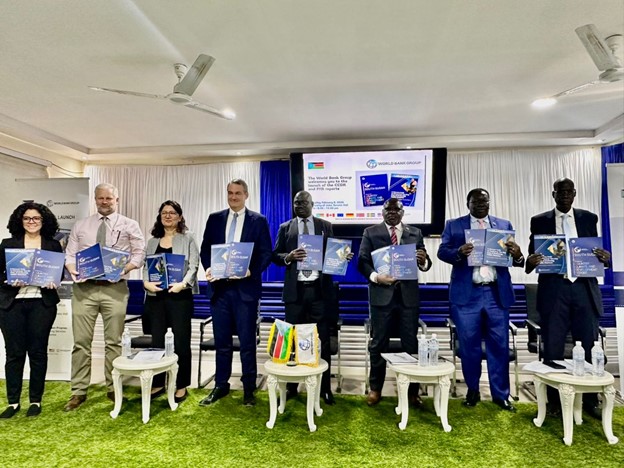
Speaking at the launch of the report yesterday, Benjamin Ayali Koyongwa, Undersecretary for Planning at the Ministry of Finance and Economic Planning, said:
“The Public Finance Review provides a practical and timely roadmap for restoring economic stability in South Sudan,” Ayali said.
“As a government, we are committed to taking immediate steps by accelerating the implementation of public financial management reforms and strengthening fiscal discipline. These reforms are essential to rebuilding trust, stabilizing our economy, and delivering basic services to our people.”
For his part, Charles Undeland, the World Bank Group’s Country Director for South Sudan, said, “South Sudan is at a pivotal moment. Climate change is no longer a distant threat—it is a daily reality reshaping the economy and communities.
However, by improving public financial management, prioritizing climate-smart policies and investments, strengthening institutions, and protecting essential services, the country can set itself on a more resilient and sustainable development path.”
He added that the World Bank Group stands ready to continue supporting the government in these critical steps.
In the same context, Prof. John Apuruot Akec, Vice Chancellor of the University of Juba, explained that the key drivers of economic recovery include the centralization of funds, improved coordination, revenue mobilization, and the development of human capital skills.
The two reports were launched under the theme:
“The Narrow Path to Recovery: Finding a Climate-Smart and Stable Path for South Sudan’s Economy.”
The Country Climate and Development Report (CCDR) highlights that South Sudan’s natural wealth lies in its fertile land, water systems, and renewable energy potential, which could serve as key engines of growth. The report underscores climate-informed inclusive growth as a central pathway to building resilience and identifies five key priorities for addressing the impacts of climate change.
These include: Strengthening flood management, including early warning systems, community preparedness, and rehabilitation of critical infrastructure; Investing in climate-resilient agriculture and livestock production; Expanding decentralized (off-grid) renewable energy solutions to support resilience, health and education services, and economic diversification; Accelerating governance and public finance management reforms to channel resources toward climate-smart investments and; Enabling the responsible and sustainable use of natural capital, particularly forests, fisheries, and wildlife.
Country Climate and Development Reports are a key tool for integrating climate and development considerations. They help countries prioritize adaptation and mitigation actions in line with broader development goals, while providing data, cost estimates, and practical measures for transitioning to a low-carbon, climate-resilient economy.
Meanwhile, the Public Finance Review recommends urgent measures to stabilize inflation, strengthen the exchange rate, and rebuild trust with partners.
These include committing to channeling all oil revenues into the National Revenue Fund, publishing quarterly oil data, prioritizing monthly salary payments, publishing budget execution reports, refraining from non-concessional or oil-backed borrowing, and ensuring parliamentary oversight of advance payment arrangements.
The two reports conclude that devastating floods, rising temperatures, and increasing climate shocks are reshaping livelihoods and exacerbating social vulnerability—particularly among women, pastoralists, and communities dependent on natural resources.
They also emphasize that weak institutions, opaque revenue management, and poor allocation of public spending remain structural constraints to development.
The CCDR projects that South Sudan will require more than USD 13 billion in climate adaptation investments by 2050, at a time when severe flooding has become the “new normal,” inundating up to a quarter of the country in some years and worsening food insecurity and declining agricultural productivity, including a projected 8% reduction in sorghum yields by 2050.
Utilities
“South Sudan is at a pivotal moment. Climate change is no longer a distant threat—it is a daily reality reshaping the economy and communities,” Charles Undeland, the World Bank Group’s Country Director for South Sudan, said.