China’s Humanitarian Footprint in South Sudan: Bonds Built for Prosperity
China’s contribution to South Sudan’s development goes far beyond roads and bridges; it is a story of solidarity, education, strategic partnership, and human-centered cooperation
By Emmanuel Mandella
When South Sudan became the world’s youngest nation in 2011 after independence, experts advised that building a stable economy and functioning institutions would require external partnerships rooted in more than profit. Fourteen years later, one country continues to stand out in that journey: the People’s Republic of China.
Long before the signing of the Revitalized Peace Agreement, before the uplift of the Juba International Airport terminal, and before students began flying to Beijing on government scholarships, China was quietly but steadily investing in South Sudan’s future, not only through infrastructure, but also through humanitarian support, political capacity building, and community assistance.
Today, China’s contribution to South Sudan’s development goes far beyond roads and bridges. It is a story of solidarity, education, strategic partnership, and human-centered cooperation, a partnership many experts say is shaping the nation’s economic and political destiny.
Meanwhile, during the country’s recurring floods, food shortages, and displacements, China has continued to provide emergency humanitarian support. From food donations to life-saving medical supplies, Chinese assistance has reached conflict-affected regions where humanitarian access remains limited.
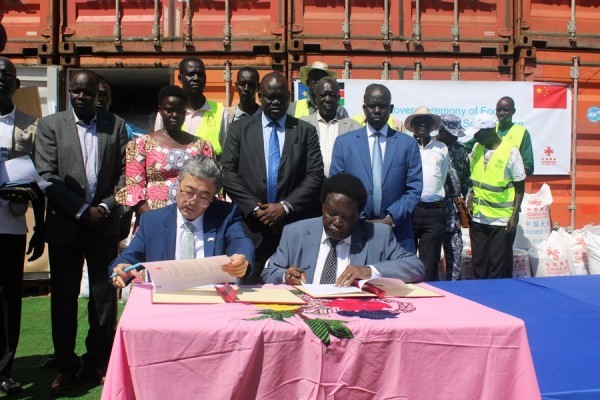
In December last year, for instance, China donated about 1,000 tonnes of emergency food assistance (including rice and wheat) to the ten states and three administrative areas of South Sudan to support displaced persons due to floods, and Sudanese refugees and returnees who fled the ongoing conflict in neighboring Sudan.
Civil society activist and Executive Director of Community Empowerment for Progress Organization (CEPO), Edmund Yakani, says Chinese humanitarian support has been essential, especially during crisis moments.
“The Chinese government has consistently provided humanitarian aid without political conditionality. Their focus has always been on saving lives first. For communities displaced by conflict or hunger, this means dignity. It also means trust is built between governments and their people,” Yakani tells The City Review.
China’s emergency response , he says, has been particularly visible through medical support, food donations, and agricultural aid, which help sustaining vulnerable households long after the crises.
In Jebel, Juba County, 45-year-old Nyibol Yak remembers how her family benefited from Chinese medical donations distributed through a government clinic during the cholera outbreak years ago.
“People were dying; we had no medicine. When the drugs came, many lives were saved, including my two children,” Nyibol recalled.
“To us, China is not just building roads. They save our lives with medicine.”
Her story mirrors what thousands of households experienced across the flood-prone Jonglei region and war-affected communities in Upper Nile and Western Equatoria, where donated Chinese medical kits, mosquito nets, and food staples helped struggling communities survive difficult periods.
While humanitarian aid addresses immediate needs, China has also invested heavily in long-term human development. Each year, a growing list of South Sudanese students receive scholarships to pursue degrees and advanced training in China, contributing to a pool of experts in medicine, engineering, diplomacy, and economics.
South Sudanese economist Dr. Abraham Maliet says China remains one of South Sudan’s most strategic partners, not only in economic development but also in political cooperation and leadership growth.
“The relationship between South Sudan and China is historic and multifaceted. It extends to political party cooperation where the SPLM (ruling Sudan People’s Liberation Movement) and the CPC (Communist Party of China) share people-centered ideologies focused on national development,” he said.
Maliet highlighted that political exchanges with China is strengthening leadership capacity within South Sudan.
“I personally led a delegation for a one-month training on South Sudan Economic Development, mentored by senior Chinese officials. That type of support builds strong institutions and shapes informed leadership,” he explained.
China’s investments in critical infrastructure such as the Juba International Airport terminal, Oil infrastructure, and the Shandong highway have become lifelines for trade, transport, and national integration.
“China has been instrumental in building our economic pillars. Their projects are not just business, they are strategic contributions that support our economy,” Dr. Maliet said.
The oil partnership alone contributes significantly to South Sudan’s state revenue, funding salaries, government operations, and services that touch ordinary citizens’ lives.
South Sudan’s diplomatic alignment with China is also shaped by Beijing’s supportive role in international forums. According to Dr. Maliet, China has been steadfast in defending South Sudan from punitive UN resolutions that could harm its fragile economy or peace trajectory.
“China has stood with South Sudan even during critical United Nations decisions. This shows our partnership is rooted in mutual respect and protection of national interests,” he emphasized.
A senior official from South Sudan’s Ministry of Foreign Affairs who requested anonymity because he is not authorized to speak publicly said China’s humanitarian cooperation creates more than aid; it builds national identity and shared destiny.
“When a partner supports you in your most difficult moment, it creates permanent friendship. China has not only given us aid; they have given our youth skills, saved our communities during floods, and built the generation of future leaders,” he said.
“That is how diplomacy becomes a relationship of people, not only governments.”
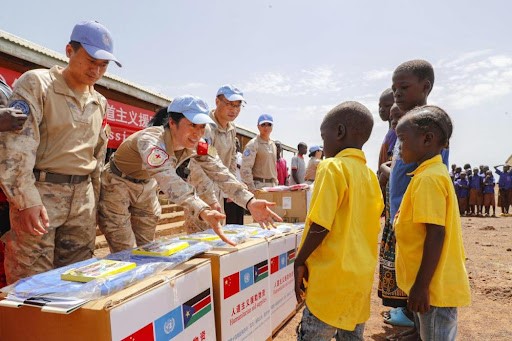
Chinese peacekeepers donate humanitarian food supplies to primary school pupils in South Sudan. [Photo: Courtesy]
Experts say South Sudan must maintain and expand this partnership through joint agricultural projects, technological and industrial capacities, renewable energy investments, expanded scholarship programs, and strengthened political diplomacy.
As parting shot, Dr. Maliet says: “China has walked with us in difficult times and invested in our future. Their support has been transformative. As a nation, we must nurture this partnership for our economy, our political institutions, and our human development.”
China’s contribution to South Sudan is not measured in monetary value alone, but in lives saved, leaders trained, students empowered, and infrastructure that binds communities together. It is, ultimately, a humanitarian and developmental journey written not in the language of politics, but in the everyday lives of South Sudanese citizens.