Cancer Network launched as country reports spike in annual Cancer cases
Warning: Undefined array key 0 in /home2/cityrevi/public_html/wp-content/themes/_city/single.php on line 65
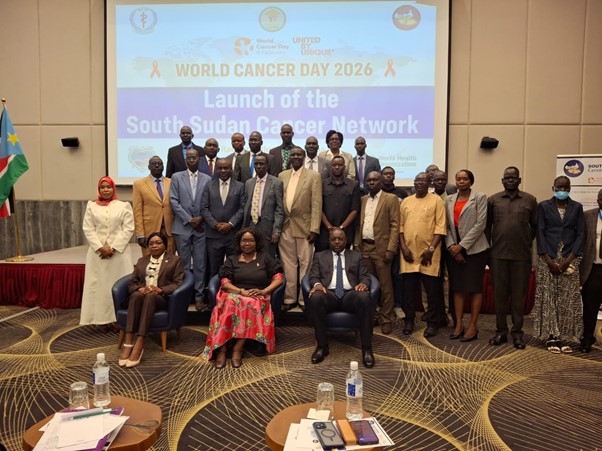
Event reveals staggering data, that cancer is responsible for up to 7% of deaths in South Sudan, with about 6,000 diagnosed annually, majorly with breast, cervical, prostate, liver, and colorectal cancers
By Ajah Jennifer and Chuol Chanyong
South Sudan and its partners on Wednesday launched the South Sudan Cancer Network to confront the growing cancer burden in the country.
The event brought together government leaders, health professionals, civil society, and international partners.
The launch coincided with the commemoration of the World Cancer Day, which was held in Juba.
The event was attended by Vice President and Chair of the Service Cluster, HE. Josephine Lagu and Governor Emmanuel Adil where speakers emphasized that cancer is no longer a distant challenge but a pressing public health emergency in South Sudan.
According to data presented at the event, cancer is responsible for up to 7% of deaths in South Sudan. Breast, cervical, prostate, liver, and colorectal cancers are among the leading causes.
Limited diagnosis to a global threat
However, the true burden remains unclear due to the absence of a national cancer registry. Globally, cancer is the second leading cause of death after cardiovascular diseases. In South Sudan, limited diagnostic capacity, late detection, and lack of specialized treatment facilities mean that many patients are either sent home without care or forced to seek expensive treatment abroad.
Speaking at the event, the Vice President for the Service Cluster, Josephine Lagu, described cancer as a “killer disease” that can no longer be ignored by the state.
She said roughly 6,000 South Sudanese are diagnosed with cancer annually.
“This is simply unacceptable,” Vice President Lagu stated.
“As a government, we must do all we can to ensure that in years to come, we reduce these appalling statistics to something that is decent and respectable,” Lagu said.
The Vice President highlighted that cancer in South Sudan is often a “hidden agenda” brought to light only when it is too late.
Due to weak diagnostic capacity and constrained oncology services, most patients are diagnosed in advanced stages when treatment options are virtually non-existent.
Lagu pledged to work with Parliament to push for an immediate increase to at least 4% or 5% in the upcoming fiscal year.
“Health must come first because it is a matter of life and death,” she emphasized, noting that the current reliance on external donors is unsustainable.
The Vice President also noted that the fight is deeply personal for her family, announcing that the Joseph Lagu Foundation will join the national effort.
She concluded with a call for a multi-sectoral approach, involving the government, academia, and civil society to ensure that “where you live or how old you are” no longer determines whether you survive cancer in South Sudan.
The Minister of Health, Sarah Celto, revealed the “difficult decisions” facing her ministry, saying that the health sector is currently grappling with a severe funding gap.
While the health budget technically remains at 1.3% of the national total, the Minister noted that rampant inflation means the actual purchasing power is lower than in previous years. Currently, 85% of South Sudan’s health budget is funded by international donors, while the government is currently meeting less than 2% of its 50% co-funding target, leading to budget cuts in some health facilities under the Health Sector Transformation Project.
The Minister outlined an ambitious baseline protocol to identify gaps and guide interventions. Central to this plan is the move from “invisible” cases to a data-driven approach through the establishment of the country’s first formal cancer registry.
The governor of Central Equatorial State, Hon. Emmanuel Adil, emphasized that the battle against the disease is as much about social change as it is about medical treatment. Fulfilling a critical need for infrastructure, Governor Adil officially committed to providing land within Central Equatoria for the establishment of the National Cancer Centre.
”We have the ability and the professionals; what we need is the space and the collective will to fight together,” he stated.
He revealed that he had met with leaders of the South Sudan Cancer Network (SSCN) weeks before finalizing this support, noting that the location would be accessible and ready for development once resources are mobilized.
Governor Adil also addressed the emotional weight of a cancer diagnosis, calling on the public to treat cancer as a standard medical condition rather than a source of shame.
“We must fight stigma so that a diagnosis doesn’t look like a death sentence. Our actions as a community must support those affected, not isolate them.”
The Governor noted that cancer affects everyone, including those at the highest levels of leadership and their families.
“We do not have to be scared,” he urged, “Together we will overcome.”
His address concluded with a blessing for those currently battling the disease and a call for the international community and NGOs to “amplify their impact” by partnering with the state and national government to turn these plans into reality.
The Cancer Network
Dr. Stephen Francis, Secretary of the South Sudan Cancer Network, emphasized that the network is designed to be more than just a medical association; it is a “human challenge” coordinator.
He framed the network as the central pillar for a multi-sectoral approach involving aligning with national health priorities, providing a technical platform for specialists, bridging the gap between clinical care and patient advocacy and securing technical and financial support for sustainable care.
Dr. Francis also noted that the network’s primary mission is to transform the national psyche regarding the disease. “Together we can build a future where cancer is detected earlier, treated effectively, and faced with hope rather than fear,” Dr. Francis declared.
There was also testimony from cancer patients like Elizabeth Ayen, whosehusband shared the harrowing reality of a family broken by cancer and medical debt.
Bak Guot Bak standing beside his wife, who was too weak to speak and gripped by pain, he delivered a emotional testimony on behalf of his wife.
Elisabeth was diagnosed with throat cancer in Juba in 2024. Like many South Sudanese families who can afford it only through “collective responsibility” and community contributions, they went to India for treatment.
The husband’s account detailed a grueling cycle of seven months in India, undergoing chemotherapy, radiotherapy, and complex robotic surgery to remove her throat. Despite the support of friends and the South Sudanese-American community, the family has been “emptied” by the cost of care. Elisabeth now suffers from a “complete blockage” requiring an external feeding tube and expensive medications to manage severe, non-stop pain.
“Nowadays, she cannot get relief from painkillers,” her husband said.
“She is crying the whole night. I am affected completely. When I see her, I don’t even know where to go.”
The ‘killer health insecurity’
Bak called for a shift in national priorities.
He noted that while the government is understandably preoccupied with traditional insecurity, there is a silent “health insecurity” killing the population.
“Your Excellency, tell the Head of State: we are busy about insecurity in the country, but there is another insecurity—and that is cancer.”
He pointed to India’s model, where the leading cancer institutions are government-owned and accessible to the public, contrasting it with South Sudan’s lack of a single specialized institute for its 12 million citizens.
Bak described himself as “the luckiest among South Sudanese” simply because he managed to get his wife to India once.
He asked the gathered ministers a haunting question: “What about the rest?”
His testimony served as the ultimate justification for the South Sudan Cancer Network:
The newly launched South Sudan Cancer Network aims to coordinate efforts across government, academia, and civil society to strengthen prevention, early detection, treatment, and palliative care.
The network will also advocate for the establishment of a national cancer centre and cancer registry. The launch of the South Sudan Cancer Network signals a new era in the country’s health sector.
Leaders pledged to prioritize cancer services, invest in medical training, and strengthen partnerships with universities and hospitals.
Utilities
“We must fight stigma so that a diagnosis doesn’t look like a death sentence. Our actions as a community must support those affected, not isolate them.”- CES Governor Emmanuel Adil.