UNDP $16.8Million grant to boost S. Sudan’s rural agricultural enterprises
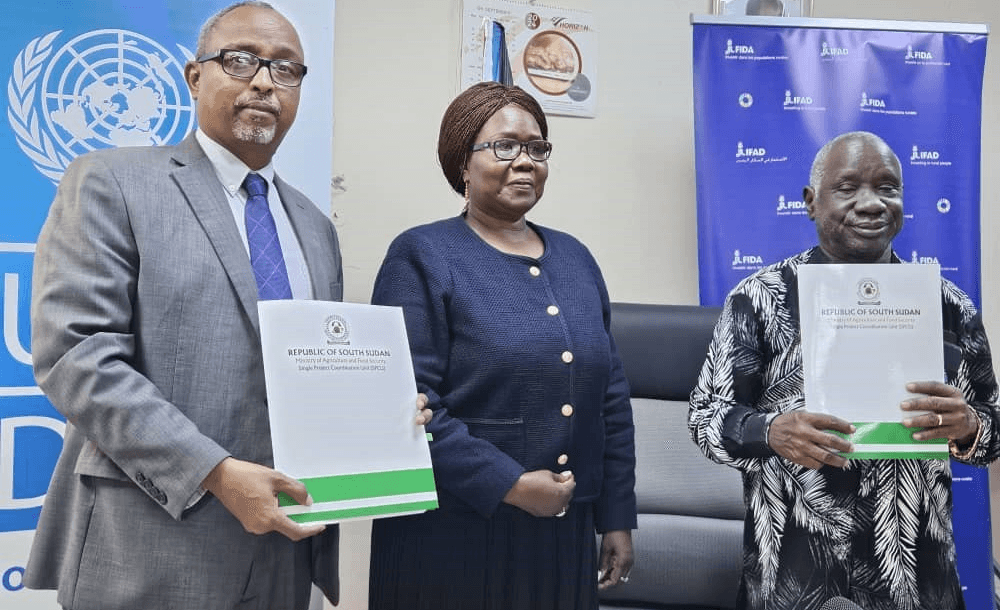
The fund aims to transform the agricultural sector in the country by improving food security, increasing income levels, and enhancing resilience against economic and environmental shocks.
By Emmanuel Mandella
The United Nations Development Programme (UNDP) and the Ministry of Agriculture and Food Security have signed a USD 16.8 million grant to launch the Rural Enterprises for Agricultural Development (READ) program.
The initiative, supported by the International Fund for Agricultural Development (IFAD) and the Global Agriculture and Food Security Program (GAFSP), aims to transform the agricultural sector in South Sudan by improving food security, increasing income levels, and enhancing resilience against economic and environmental shocks.
The READ program is set to empower Rural Producers’ Organisations (RPOs), Agricultural Producer Groups (APGs), cooperatives, and micro and small enterprises (MSEs), enabling them to become key players in sustainable and resilient agricultural value chains. The initiative will also focus on enhancing production capacities, facilitating access to markets and financial services, and strengthening the policy framework supporting rural enterprise development.
Speaking on the impact of the initiative, a representative from UNDP said, “Our commitment is to build resilient rural enterprises that not only strengthen food systems but also uplift communities, ensuring that households can withstand both economic and environmental challenges.”
The program will be rolled out in five states—Central Equatoria, Jonglei, Upper Nile, Western Equatoria, and Eastern Equatoria—targeting approximately 162,315 households across seven key agricultural value chains. The ultimate goal is to improve food security, increase rural incomes, and promote environmental sustainability through climate-resilient farming practices.
With this multi-million-dollar partnership, South Sudan’s rural communities are poised for transformative growth, helping to strengthen the nation’s agricultural backbone and contribute to long-term economic stability.
Notably, South Sudan has a huge but unrealized agricultural potential, with favourable soil, water, and climatic conditions rendering more than 70 percent of its total land area suitable for crop production.
According to a report by the United Nations Food and Agricultural Organization, up to 95 percent of the country’s population depends on farming, fishing or herding to meet their food and income needs. Yet, South Sudan faces one of the world’s worst humanitarian and food security situations.
Cognizant of the potential impact of the agricultural sector to the economy, President Salva Kiir, in his address at the high- level meeting on state governance on the sidelines of the 9th Summit of the Forum on China-Africa Cooperation (FOCAC) in Beijing, promised to modernize agriculture in order to increase food production in the country.
Th head of state said that the country’s priorities include modernization of agriculture through adoption of modern technologies to increase food production and boost trade. Further, he called on for strengthening the technical capacity of South Sudanese to manage the process of modernizing the agriculture sector.
READ is a program poised to transform South Sudan’s agricultural sector and boost the country’s food security by building the capacity of rural households and sectors- the very primary lifeblood contributors of human capital to the sector.
The program will not only facilitate formation of strengthening of RPOs, provide training and capacity-building initiatives, facilitate access to rural financial services and help in the implementation of policy and regulatory frameworks supporting rural enterprises, but it will ultimately ensure that RPOs and their members increase production and productivity, have access to markets and financial services and strengthen policy and institutional framework supporting rural enterprise development, among other initiatives.